I am feverishly finishing the book manuscript, and so have been sitting on this blog for a while, not sure I should even publish it in this political climate. I would hate to write a “both sides” type of argument – this is not that.
But about three weeks ago, one of my students wrote this in her one-pager for Global Environmental Health:
I struggle to know the difference between real and fake news. Teaching people how to spot differences between the two could overall benefit us as a nation. A perfect example of this is the Tylenol causing autism debate. President Trump recently came out and announced that autism is caused by pregnant mothers taking Tylenol. Later on, Tylenol came out and made a rebuttal post. I feel a lawsuit coming very soon.
The FDA, an agency under Health and Human Services that is headed by RFK, Jr., is changing the label on Tylenol, and many professional organizations are in an uproar over the change. Trump, per usual, significantly distorted the message.
The thing is, although the link between Autism Spectrum Disorder (ASD) and acetaminophen is small, the studies identifying it are robust, with a huge number of subjects, which should give us pause. Acetaminophen is almost certainly not the major cause of ASD; there is much better evidence linking the condition to heavy metals, pesticides, Endocrine-Disrupting Chemicals (EDCs), air pollution, and an array of other chemical culprits. However, there could be some association; for once, more research is indeed needed.
Vaccines have not been causally linked to ASD, which RFK and many others have gotten wrong because of one influential but spurious article published in The Lancet and then subsequently retracted.
But in the rush to discredit RFK, some academics and healthcare providers who should know better have been making blanket statements that are also not true, saying that there is no evidence of a link, or even that there are no environmental causes of ASD, which is patently untrue. I suspect they are adhering to orthodoxies they have not checked with a recent literature search.
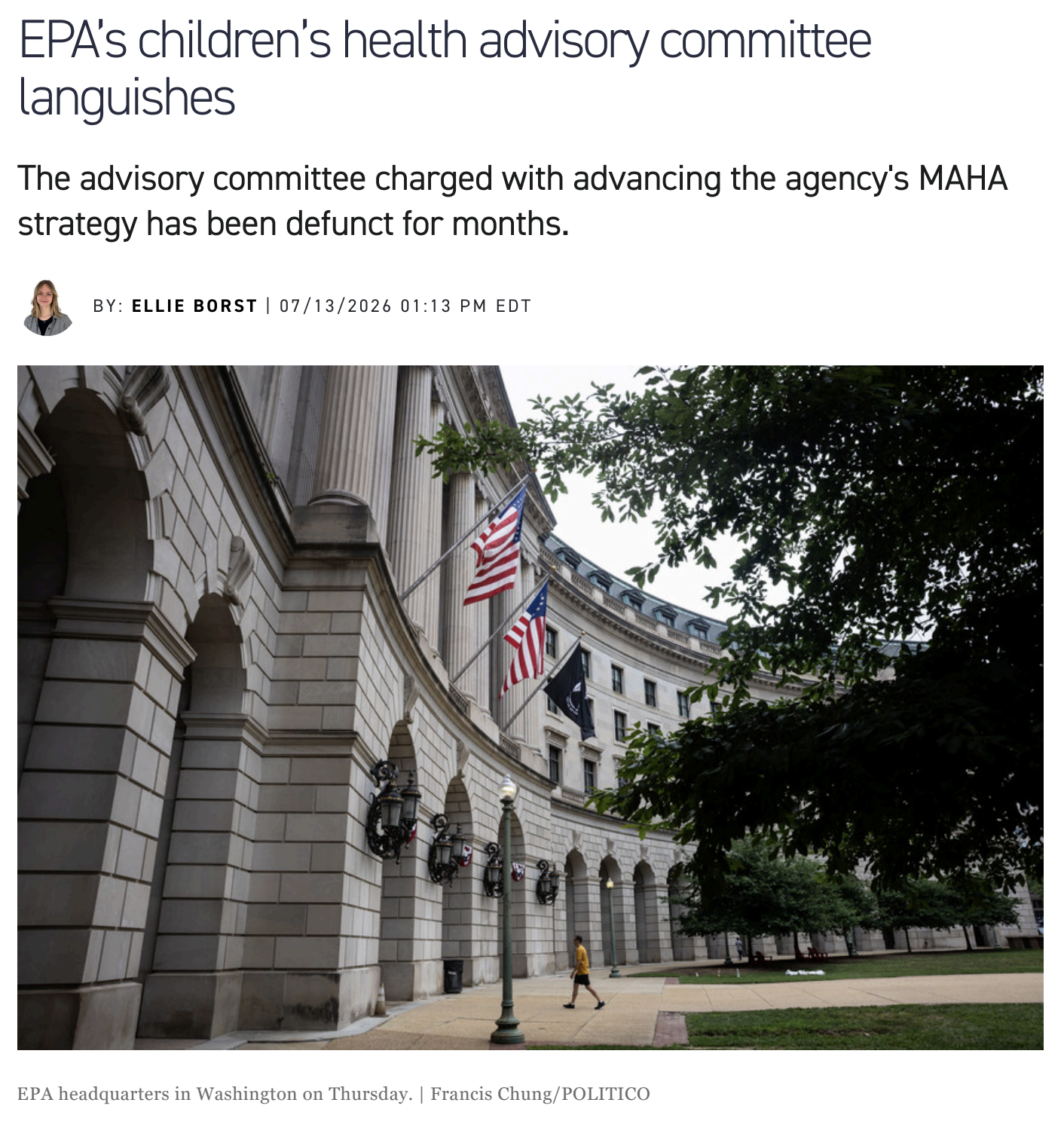
The truth is, talking about causation is complicated and should often be more nuanced than our polarized politics easily allow. And this conversation is occurring in a larger context in which EPA is enjoined to support the priorities of MAHA, at the same time that this administration is gutting its essential ability to do so.
Project TENDR and PRHE, two scientific organizations of the top scientists I trust most are also taking the opportunity to talk about disease causation – because we do know enough about causes of ASD and other environmental diseases to prevent many of them:
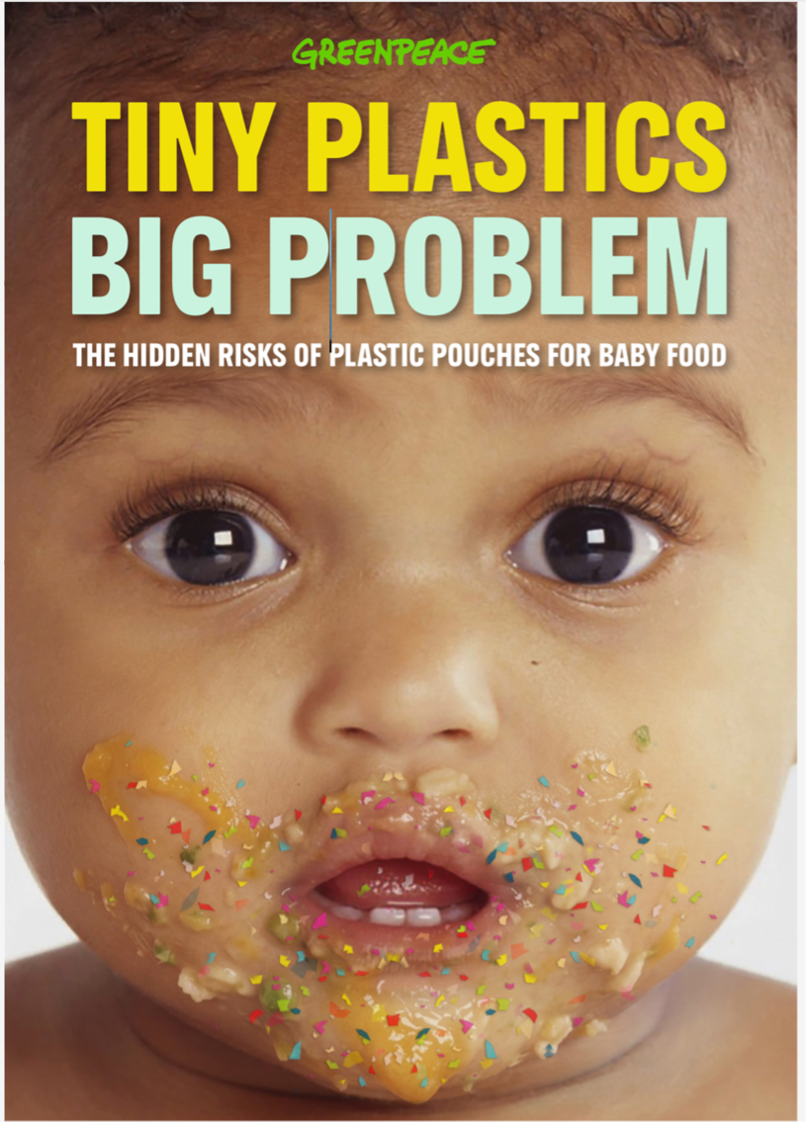
We have the opportunity to reduce cases of autism, attention deficit hyperactivity disorder, learning disabilities, and other neurodevelopmental conditions by banning the use of chemicals that can harm children’s brains, reducing air pollution, and keeping plastics away from food and drink.
The current Administration’s path of dismantling environmental regulations that protect health, firing scientists, and defunding research means more children will develop autism and other brain disorders and puts our children and future generations in harm’s way.
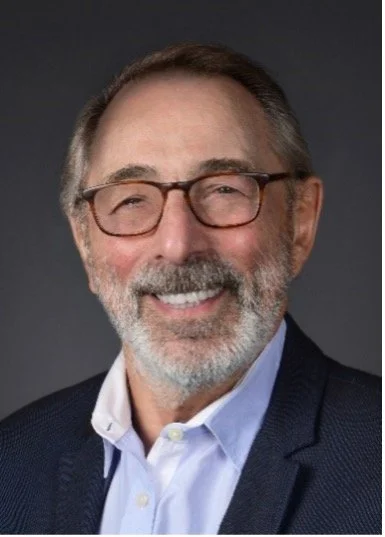
I subsequently talked for an hour and a half with Dr. Mark Miller at UCSF. He affirmed that the research the acetaminophen claim is based on is robust, legit, and reason for precaution: https://pmc.ncbi.nlm.nih.gov/articles/PMC12351903/ He and I agree that the backlash against the many instances of anti-science nonsense and deep cuts to meager protections can take things too far in a different direction. He wonders if some of the voices saying there is no link between environmental toxicants and autism have even read the body of research he and I are familiar with.
It's not like PBS to get it wrong, but they do, saying in bold font that “evidence does not support idea [sic] that an ‘environmental toxin’ [sic] is causing autism. The experts they talked to, none of whom I recognized from Children’s Environmental Health (CEH) publications, say none of the exposures have been “conclusively proven,” but that is an impossible bar to clear, given the fact that we cannot ethically do double-blind studies that deliberately expose children to environmental chemicals, though that has been done in the past.
I have also heard scientists and healthcare providers mock RFK for saying that fluoride causes IQ loss. But actually, this connection is well established. There is a small but consistent IQ decrement with fluoridated water. Does that mean we should not add fluoride to water? Again, it’s complicated. If all children received excellent dental hygiene from birth on, and if children weren’t fed excess sugar from early on, then fluoridation would probably be unnecessary. But they are, and cavities also present health risks. Some say that adding fluoride to tap water was a way for big sugar to avert attention to the rotting mouths their products were causing. And we know that industry has perverted the regulatory agencies in fundamental ways over decades.
Many outlets framed this in a familiar way: that causation is not “proved,” that “more research is needed.” But how much more evidence is needed? Where is the bar? This framing is largely a cop-out, an excuse for continuing a [new] status quo supported by industry.
What should pregnant women do as far as using acetaminophen? If I were pregnant with a high temperature that might also harm the baby, I would take acetaminophen. But would I pop some pills for moderate muscle aches? Perhaps not. Life is all about balancing risks and benefits.
This point, that real people have to make decisions in real time, based on the evidence available, was brought home by another student, who said her mother asked the OB/Gyn repeatedly if it was okay to take acetaminophen during pregnancy – and then gave birth to her sister, who was later diagnosed with ASD. This issue is painfully personal for them. Should her mother feel badly about her decision? Absolutely not. She made the best choice she could at the time, and there is no way to say that that exposure – among the many that are unavoidable – contributed to her sister’s condition. Should future OBs say anything about this possible connection to future patients who ask? Yes – they should give them the full information available at the time and then allow the patient to make the call.
I recently spoke with the head of my county health department and had a wonderful conversation about the communication of risk. During COVID, they developed a phrase that takes into account uncertainty when science is provisional and that respects people’s varying tolerance of risk: “We believe it is safest when….” This phrase articulates the best advice and also foregrounds the agency of individuals. Ultimately, while some issues are clear – playing the odds will almost always favor vaccines, for example – other decisions remain shaded in grey. And ideally, we should communicate that too.
My take on all this? We need to retain our critical thinking skills and fact check all sides. As someone who has always been independent, I resist identifying with a political party even now, when Republicans have transformed into the party of science denialism and fascism – even though I may only vote for Democrats from now on, if that continues to be the only ethical choice. Why? Because I see how things can go when you choose a political party like you choose a football team, out of tribalism and blind loyalty, red or blue, and then stick to it no matter what. Parties can change and do. The Republican Party was once the party of Lincoln, and now…?! Our first commitment – in civil society, as well as in science and health – should be to the truth – based on the most trustworthy evidence, so far as we can discern it.