A reporter at E&E News at Politico, Ellie Borst, wonders what is happening with the Children's Health Protection Advisory Committee (CHPAC) to the EPA, on which I have been honored to serve over the last three years.
She called me asking what I knew, which is not much since we have heard nothing about reappointments, which were due out in March. Although as a strong participant, I would normally be asked back for another three years, I have prepared myself to not be called to serve again. Why? Not just because of my very frank questions to the Deputy Administrator at our last meeting in August, 2025, but also because many of us expect this committee to be gutted like so many others, and its empty carcass handed over to the petrochemical industry and stuffed with industry lackeys. It will then be a committee advising on children's health in name only, as has happened with much of the EPA under both Trump administrations. Talk about a wolf in sheep's clothing!
What remains? Before our terms ended, we succeeded in sending a letter on plastics to Administrator Lee Zeldin. The EPA would usually have responded to the letter by now, but we have heard nothing. Nevertheless, there is much to be gained by reading the document, whose writing was headed by UCSF's Veena Singla, at https://www.regulations.gov/document/EPA-HQ-OA-2025-0261-0029 There is also a story there--you can read between the lines--since for the first time in the history of the committee, there are two documents rather than one consensus letter. If you are curious what that is about, just notice the affiliations of those on the letter signed by most of the committee--Harvard, Columbia, UCSF, UC Davis, and more--and the affiliation of the one person who signed the dissenting letter--Bayer-Monsanto. Read carefully. Now imagine the kind of letters that might be written by a committee mostly composed of industry representatives.
What do I think will happen with CHPAC? I would be surprised if the committee were allowed to proceed as anything resembling its former self because -- particularly since it was charged with fulfilling MAHA's mission, with which we mostly agree -- the committee is a force to be reckoned with. It is utterly predictable that both CHPAC and MAHA have been hamstrung. It is not possible for Trump to both fulfill his billion-dollar promise to the petrochemical industry and to also protect children. And of course, he is not even slightly interested in the latter.
I am quoted as asking the following question, and it's a genuine one: "Is the failure to reappoint members and reconvene the committee part of a slow-walking, greenwashing effort to dismantle voices that have been pretty strong to help protect children? Or is it just incompetence and inability to do the work because they have unfortunately lost and dismissed so many excellent people at EPA?"
I don't think E&E News will mind if I post the article here:
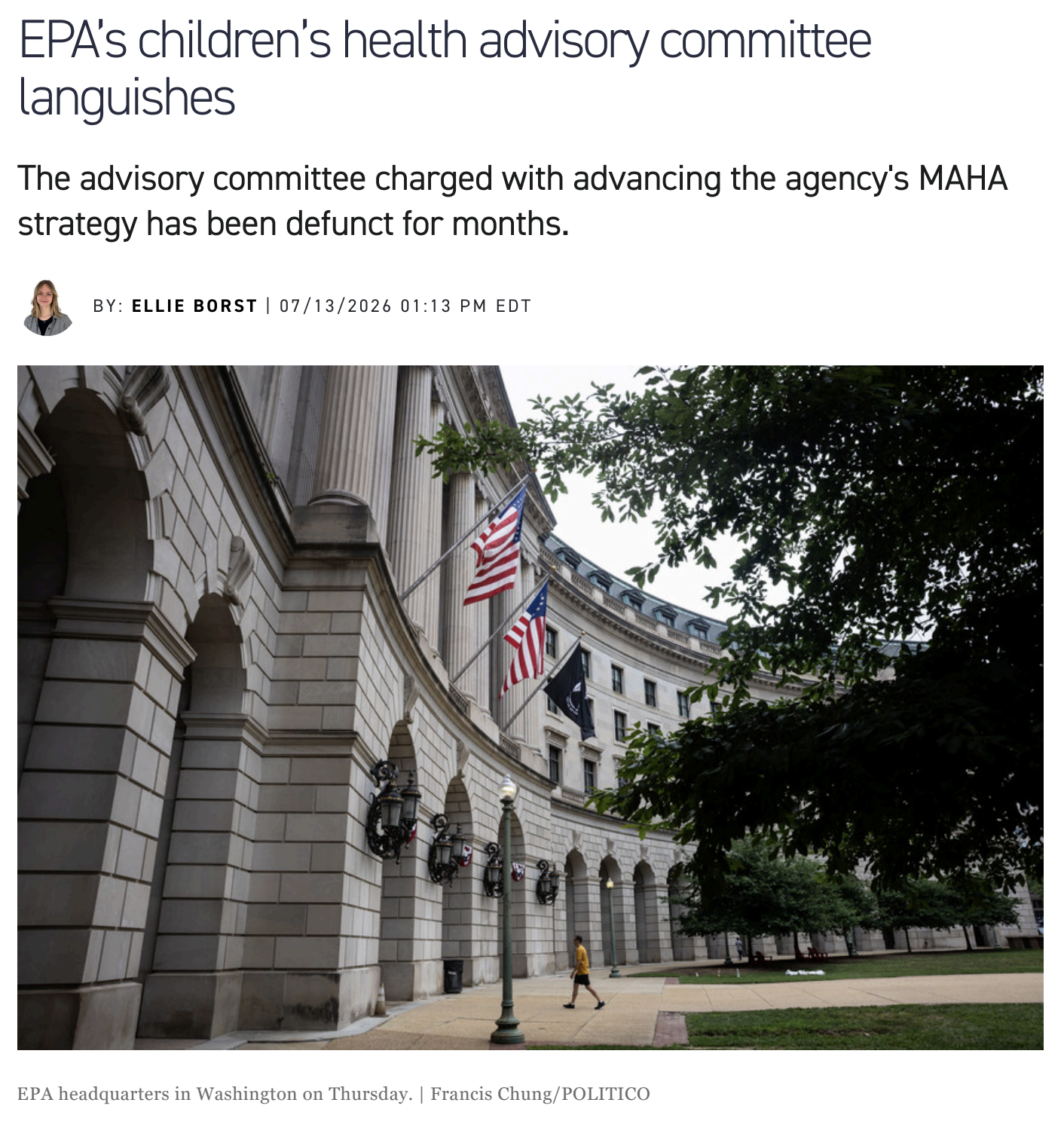
GREENWIRE | Four months after EPA's deadline for picking its new slate of children's health advisers, candidates are still waiting for answers.
The Children's Health Protection Advisory Committee is a group of outside public health specialists that EPA officials turn to when they need recommendations on regulations and policies addressing children's environmental health. Per the White America Healthy Again strategy released in September, CHPAC is also tasked with advancing research to implement the Trump administration's MAHA agenda on ending childhood chronic disease.
But members' terms expired in February, and it's been almost a year since the advisory committee last met. Some members are worried the delay — and a shortage of communication from the agency — could indicate a sidelining of expert opinions or an effort to stack the group with chemical industry scientists, rather than public health experts.
"Right now, it's just fading into nothing," said Jean-Marie Kauth, an environmental health professor at Benedictine University and CHPAC member. CHPAC consists of roughly two dozen members, chosen by the administrator for threeyear terms, with the option to reapply for a second term.
In August, EPA sent out the call for nominations of public health specialists from universities, research institutions, businesses, advocacy groups, industry, and state and local governments. The Federal Register notice says the agency "anticipates filling vacancies by March 1, 2026."
"That part seemed to proceed reasonably the same as it had, but we have not heard anything back," Kauth said. She said she indicated her desire to remain on for a second term, since members don't have to submit full applications.
EPA spokesperson Brigit Hirsch said the "nomination review process is ongoing as the Agency is carefully evaluating all qualified submissions, and EPA will announce new CHPAC members when the selection process is finalized."
Outgoing CHPAC Chair Shirlee Tan, a senior toxicologist for the Seattle and King County Public Health Department, referred questions to county spokesperson Kate Cole, who said Tan "does not have context on the delay in announcing new members" and she is no longer a member since her term expired in February.
Kauth said she expects she and "many of the really amazing professionals and experts will not be invited back," and the panel instead "will be stacked with people who work for the petrochemical and pesticide industries. And that will be truly unfortunate."
"Is the failure to reappoint members and reconvene the committee part of a slow-walking, greenwashing effort to dismantle voices that have been pretty strong to help protect children?" Kauth said. "Or is it just incompetence and inability to do the work because they have unfortunately lost and dismissed so many excellent people at EPA?"
In January 2025, the Trump administration abruptly fired members of its Clean Air Scientific Advisory Committee and Science Advisory Board — two highly influential panels of experts. While Trump officials called it a "reset," Democrats and EPA staffers reamed the move as politically motivated.
EPA Administrator Lee Zeldin later replaced many of the academic researchers with industry representatives or consultants with questionable track records.
CHPAC is one of EPA's 15 federal advisory committees. Unlike the air and chemical science boards, it isn't tied to a specific regulatory law, but House Democrats reintroduced legislation in March 2025 to codify the children's health office and make CHPAC a permanent advisory committee.
"CHPAC has consisted of the nation's leading experts to give EPA advice on how to best protect children's health," said Veena Singla, a former CHPAC member and environmental health scientist working with the Natural Resources Defense Council. CHPAC members answer charge questions from administration officials, in addition to holding public meetings every four to six months.
In November, the committee responded to a set of charge questions on how plastics affect children's health, and all but one of the advisers concluded plastic pollution "can harm children’s health and raise risks of developmental disabilities, birth defects, cancers, and other serious diseases" and urged EPA to take action.
"EPA has yet to respond, and in the meantime the Agency has taken actions counter to these recommendations, proposing to roll back pollution regulations in ways that will be detrimental to children's health," Singla said.
Reach the reporter on encrypted messaging app Signal at eborst.64.