Why aren’t we choosing to invest in saving the planet and our own lives first?
What is the eventual price tag of the AI build? And how does that compare with the total cost of going 100% wind, water, solar – as Mark Jacobson and Mark Delucchi argued we could in a mere 20 years – in a 2009 article in Scientific American and subsequent research that I have been teaching to my students ever since?
I am reminded of a recent headline published in The Atlantic that imagined Republicans awaking from their fetid fever dream of Trumpism and wondering, we destroyed the party and America for this guy? How can we all not help and marvel now, “We are destroying everyone we love and all life on Earth for this tool?” Many of my students can’t even properly cheat on their papers without AI giving them away by fabricating answers AI use has made them too dim to recognize. I have turned in about a quarter of my students for cheating already this semester, even though I have rebuilt courses to minimize work outside class – and lowered standards considerably. It is almost like I can see their reading and thinking skills slowing down in real time. Brain damage seems like a pretty accurate description.
In a 2025 article, Jacobson and others estimate the payback period for a transition to a 100% wind, water, solar system at six years. My solar also had a six-year pay-back period, after which I have received free energy, as well as contributed some back to the grid. Easy-peasy. The cost of $6.8 trillion per year for clean energy is compared to a monumentally higher business as usual (BAU) price tag (below). Fossil-fuel subsidies alone cost $7.4 trillion per year or 6.4% of global GDP, which would more than pay for the energy transition.
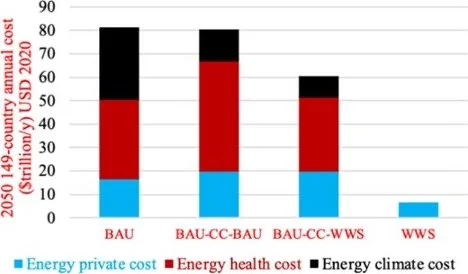
See Jacobson et al. 2025.
Jacobson puts the total price tag for global renewable energy at $62 trillion, down from earlier projections of $73 trillion, and even earlier estimates of $100 trillion – because of the declining cost of renewable energies and other efficiencies of scale.
All that may seem like a big number. But what has the catastrophically foolish war in Iran cost us so far? Nearly $50 billion, with indirect costs like damage to bases and increases prices at home amounting to hundreds of billions more. The estimated cost of post-9/11 wars in Iraq, Afghanistan, and elsewhere totals about $8 trillion, not counting the cost of borrowing to pay for them.
More to the point, what is the projected cost for building out AI? According to PricewaterhouseCoopers in conjunction with Oxford Economics, AI is expected to cost $31.6 trillion – or even as much as $50 trillion – by 2050. Should we pray the bubble bursts before all the moneys and materials are irrevocably squandered? Before the Earth is irreparably damaged?
Why aren’t we choosing to invest in saving the planet and our own lives first? There are many answers to this, but first and foremost, entrenched interests (billionaires and trillionaires invested in existing technologies) want to recoup investments and don’t care how many they hurt in the process. And they have quite literally purchased our politicians to do their bidding.
We could at least slow down so that data centers are powered by clean energies – but incredibly, even while AI founders themselves plead for regulation, governments turn the other way and refuse to lift a finger to protect us all from the end of the world – whether via the Terminator scenario or runaway Climate Change seems almost moot to them.
AI technology causes harm everywhere along the line from production to use. Just a year ago, I wrote about the harm AI causes brains, particularly developing ones. Since then, so much more has come out about these concerns, including, in particular, cognitive surrender: AI steadily conditions us to mentally bow before its often erroneous or biased conclusions. Our brains, naturally mentally lazy to conserve energy, are no match for its seductions, no more than certain students are able to resist cradling cell phones in their laps in class – as if I cannot see the steady focus of their gazes and sense their complete abstraction from their surroundings, black holes sucking up the vivid energy of the classroom..
The New York Times summarized an MIT report:
The committee at the Massachusetts Institute of Technology studying A.I. use released a number of alarming findings, including that the technology has caused “major shifts in campus culture,” isolating students who are skipping office hours and ditching communal studying. Getting answers from a bot can create “the illusion of learning” for students who reach for A.I. “at the first hint of struggle,” the M.I.T. committee wrote in its August report.
What is truly alarming is that every educator understands that it is the struggle toward an answer that builds learning. The report itself repays reading: https://aiandeducation.mit.edu/report/#27-augmentation-not-automation
The AI build-out represents not just an opportunity cost – that we could halt climate change by building out renewables instead. It also risks simultaneously making us too complacent and too stupid to respond to the crises ahead – including rampant, self-recursive AI itself.
And likewise, let us pause to consider: what were the opportunity costs of the petrochemical industry? How much good could still have been achieved if we had set up guardrails against poisoning our children? I would argue much of the essential goods for humankind could still have been gained without the wanton, reckless, malignant poisoning of every organism on earth.
We are repeating the mistakes we have made with excessive and abusive technology use before, fixing the last round of unintended consequences with another that creates yet more unintended consequences. And unlike any human catastrophe before, we are at risk of taking our entire ecosphere down with us.
One of the rare points of light in all this is the ordinary people, from across the political spectrum, fighting data centers in their own communities. Erin Brockovich (yes THAT Erin Brockovich) has heard from 9,897 communities from across the country who are protesting the destruction of their air, water, soil, and communities – as well as the non-disclosure agreements (NDAs) their elected officials have been coerced into signing behind closed doors.
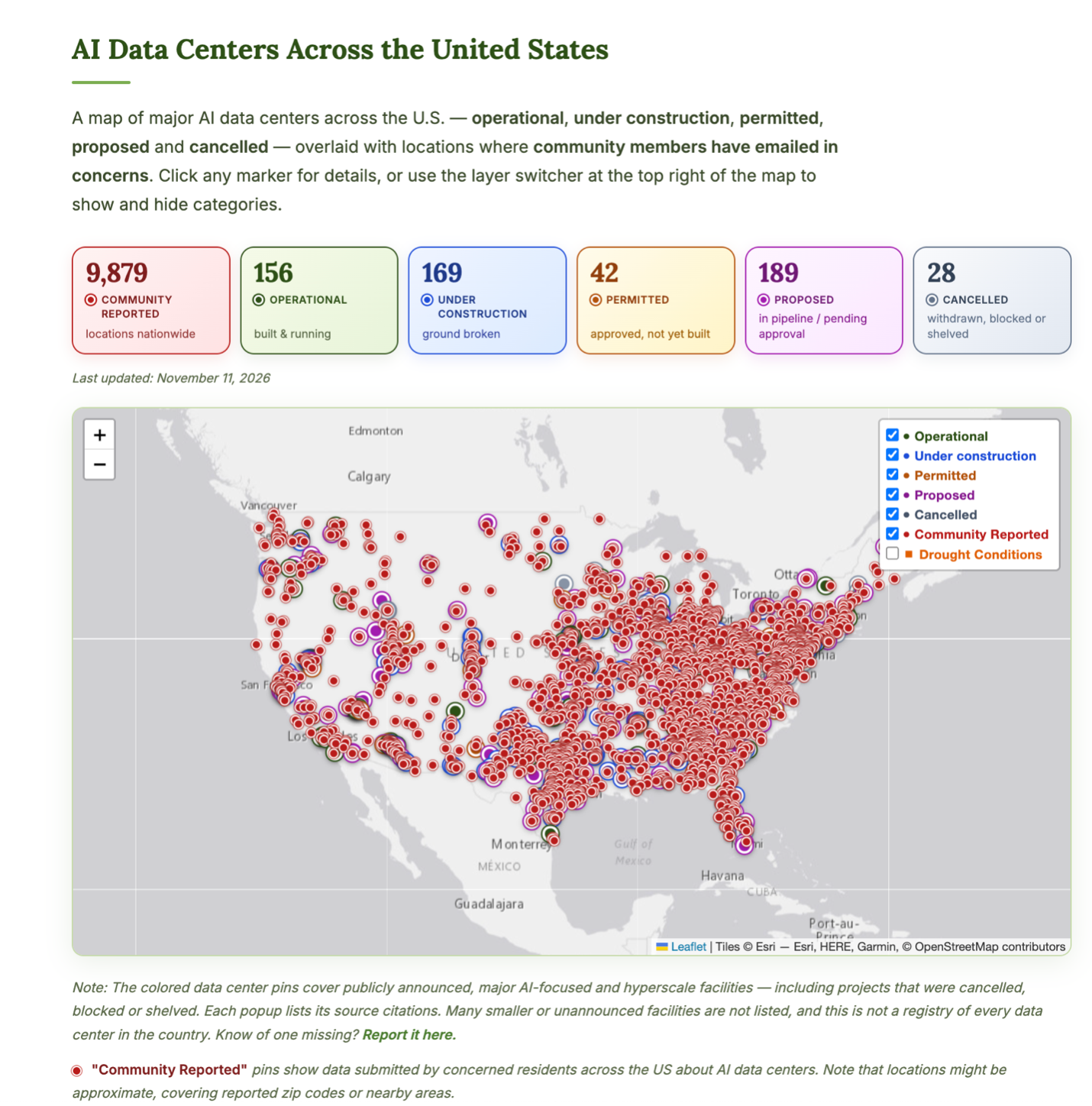
Read more at https://www.brockovichdatacenter.com/
Opportunity costs often result from perverse incentives. Many of the perverse incentives in our current system have been created by allowing amoral/immoral corporate entities to own our politicians and our political process. We must reject that, and I believe the recent blue wave is a signal that people are ready to start. We must also abolish Citizens United 2010, and most Americans support that first step towards reclaiming our political power.
The truth is the tech trillionaire and billionaires who lined up beside the evil empire at the last inauguration have no more power than what we grant them collectively. Elon Musk wasted nearly a half billion dollars trying to distort the last election – and failed. Jared Dimond describes how when societies collapse, the first ones to go are the irresponsible leaders and elites who allowed disaster, like the Mayan kings that were ritually executed when they seemingly failed their people.
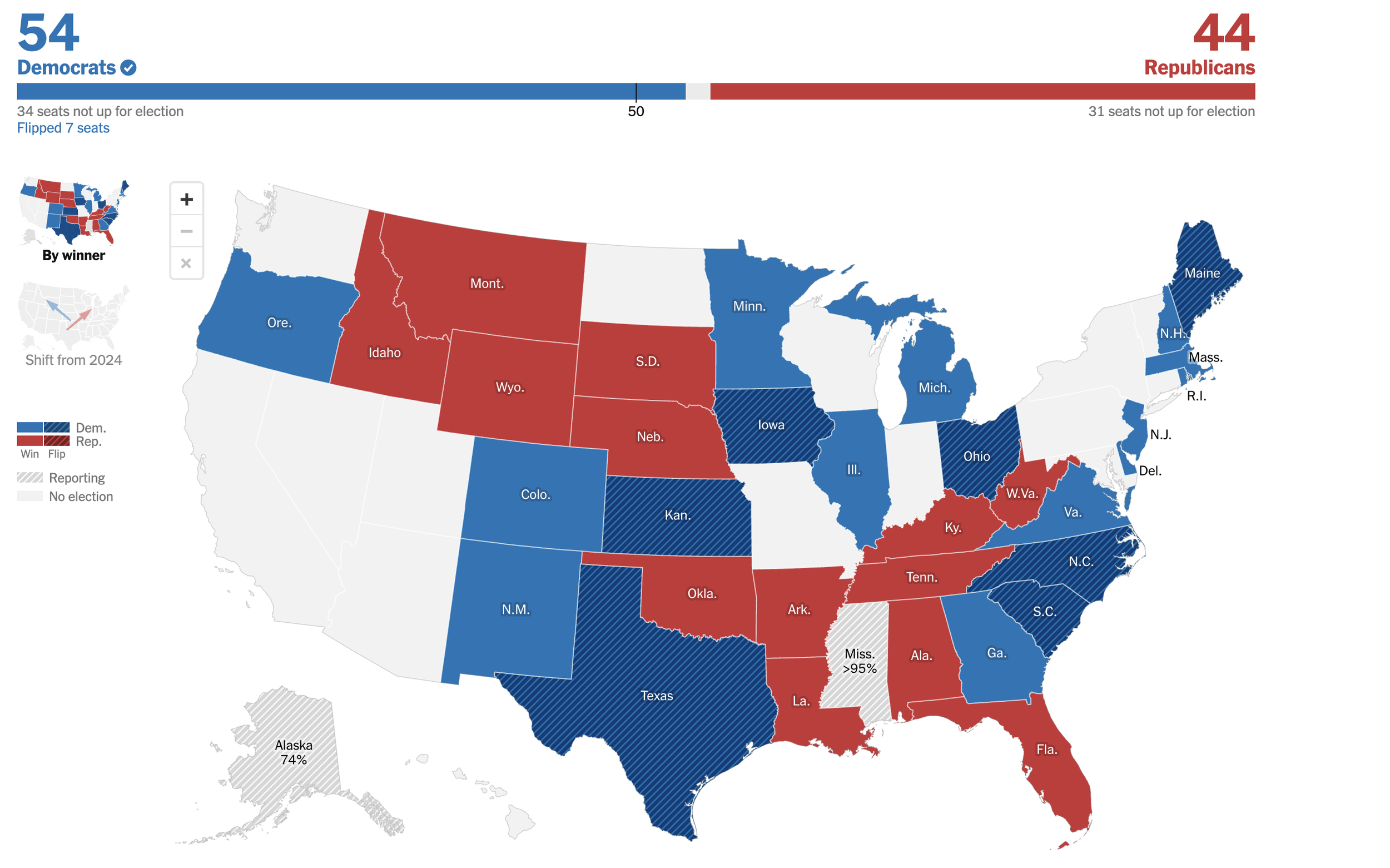
I am heartened that during the recent elections, which Democrats won overwhelmingly, turning even Texas and Mississippi blue, people united around issues that illustrate the link between corruption and human suffering – from high cancer rates in Iowa to data centers destroying communities across the land.
But make no mistake, we have a huge fight ahead to preserve the living planet on which all life depends – the real super intelligence, Gaia – against the unnatural monster being summoned from toxic e-waste by the tech hegemons of our society.
We grossly mistake what salutary ends even are, while hotly pursuing destructive means to those illusory ends. We think that if a little is good, a lot must be better. And we fail to consider the consequences of our actions, even when they are patently apparent, even to their creators, especially to their creators, as we saw with Exxon and 3M and the plastics industry and now all of the AI companies warning us they feel compelled to continue creating a product that may end all human life on earth.
Furthermore, what kind of Superintelligence has all this technology, based primarily in chemistry and physics, gained for us and the other living creatures on the planet? We have utterly ignored the other, greater Superintelligence of the living earth itself. We are just beginning to discover the miraculous complexity of the microbiome, the fungal networks of trees forming a brain underground, the intelligent feedback mechanisms of the climate, the wonders of astrobiology as a field. We have barely discovered the closest thing to God that exists on this created earth at the same time we’re killing it with our own false, mechanistic, soul-less android version of deity. That is not just opportunity cost. That is ecocide, suicide, deicide, the thanatic urge in action.
We can have a healthier future, flourishing communities, maybe even a longer timespan as a species, but that future depends not on Platonic abstractions, not on Manichean mind-body dualities, not on a Cartesian line into infinite nowhere space, but on an Aristotelian appreciation of biologic complexity that is everywhere intricate, as Annie Dillard said so poetically: “We have not yet found the dot so small it is uncreated, as it were, like a metal blank, or merely roughed in—and we never shall.”
The book I have worked towards for more than 20 years, Poisoning Our Children, is now available for pre-order at https://www.press.jhu.edu/books/title/54124/poisoning-our-children
Pre-orders are hugely important, as they affect whether bookstores stock the book, how algorithms surface it, and how seriously publishers take authors. Your support matters more than you know. All author proceeds will be donated to Environmental Health non-profits.