Dr. Shanna Swan: Brilliant Scientist, Fertility Cassandra

Are We Headed towards a Future without Children?


Shanna Swan, PhD is an award-winning scientist and Professor of Environmental Medicine and Public Health at the Icahn School of Medicine at Mount Sinai.

Her interest in epidemiological reproductive health began as she was investigating links between the contraceptive pill and cervical cancer. Then, while working at the California Department of Public Health, she found surprising levels of miscarriages and set off in quest to answer why. In 1995, she played a pivotal role on a prestigious National Academy of Sciences committee on Endocrine-Disrupting Chemicals (EDCs), during which she used her impressive statistical skills to reanalyze a preliminary study that had shown precipitous declines in levels of sperm. Her reanalysis showed the results to be surprisingly durable. In other words, she has played a seminal role in the development of the field.

Probably the best way to understand Dr. Swan’s work is to read the 2021 book she wrote with journalist Stacey Colino: Count Down: How Our Modern World Is Altering Male and Female Reproductive Development, Threatening Sperm Counts, and Imperiling the Future of the Human Race, which describes the research that links many reproductive outcomes to unwitting exposure to EDCs. She has authored more than 200 scientific articles, including one on male infertility, written in 2017, that ranked #26 in the world for impact.

Dr. Swan is funny and not, apparently, shy. To name a few, she has appeared on ABC, CBS, PBS, BBC, and in The New York Times, The Guardian, and US News & World Report. Prof. Andrew Huberman and Joe Rogan interviews are both well worth watching. Dr. Swan has plenty of time to explain her research in her own words and does a good job addressing questions that might be a little off track. If sometimes dubious in his endorsements, Mr. Rogan seems to get the basics: “we are changing what human beings are…because of poisons?” He wondered repeatedly why we don’t hear about this – but also noted that many powerful companies have a vested interest in silencing us.

With all that she has publicized about her research, I was most interested in asking Dr. Swan new questions: “I’m curious – how have you had the qualities of mind to see this pattern?” I was delighted with her reply, getting at what makes her different from so many people who are blind to or in denial about the evidence. First, she described how much she loves solving puzzles, particularly those involving data. Then she smiles and admits that “being curious – and kind of a troublemaker – I guess you have to say that’s part of it – I kept asking – why?”

This interview has been lightly edited for length and clarity.


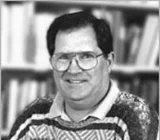
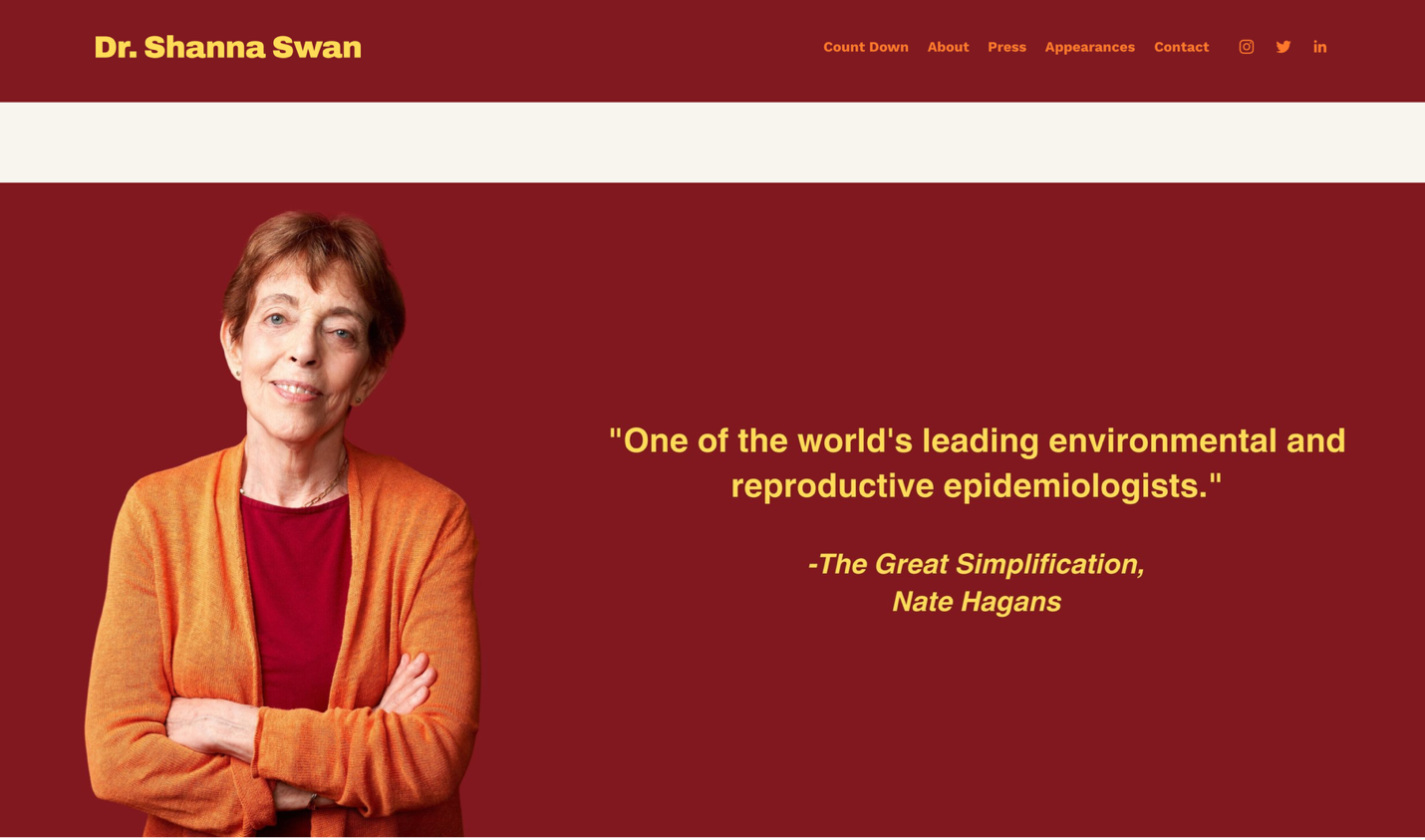
Figure 1: Dr. Shanna Swan


JMK: Hello, Dr. Swan, it's such a pleasure to meet you. It was so nice of Alison Carlson to pass my name along to you, and I really appreciate you taking the time to talk.

SS: Sure. Ali is a great connector! How do you know her?

JMK: I found out about her through Marya Zlatnik and Tracey Woodruff at UCSF. And Tracey said, you should talk to her, and so I did. It was wonderful getting the backstory of how she helped begin PRHE, which has been such a force for good for a long time now.

With your permission, I would love to blog what you tell me as well as include it in my book with Johns Hopkins.

SS: I'm not exclusive in any way, unless it has to do with something when people said, “don't talk about this.” And then I'm pretty careful, but otherwise, I talk so much that it's all out there.

JMK: I was watching your YouTube interview with Andrew Huberman.

SS: Yes – that was great, right?

JMK: Yes. And of course, your book shares so much of your past experiences as well. But I wonder if you would want to share something from your early childhood or early training that helped you get interested in this. I know that part of it is chance, right? You worked on birth control, and then you also ran into some high rates of miscarriages. But you were able to see a pattern that maybe other people weren't able to see.

SS: Let's see, there's a lot of entry points here. One is how I got into reproductive epidemiology. One is focused on phthalates, which is different but related – and then how I got into sperm decline. What specifically?

JMK: I really mean – even now, people refuse to see what is happening with environment. At the CHPAC – the Children’s Health Protection Advisory Committee to the EPA – we rub elbows with people from industry who dismiss much of the research that shows how these chemicals are affecting children. We believe it caused my daughter’s cancer. We have reason to believe it causes neurocognitive effects, reproductive effects, all of which I am interested in. And some people seem not able to recognize it. Your career path is well documented, but I’m curious about how you have had the qualities of mind to see this pattern? You are willing to believe what is happening, and you explore it, whereas others do not.

SS: Well as far as people not getting it or not accepting the evidence, I think a large part of that is the fact that scientists are not good communicators. I put myself amongst them for a long time, though I think I am doing a lot better now because of what happened.

First, writing the book with Stacey Colino, who is a superb science journalist, helped me a lot with how to talk about these things. So that was a big first step. The next thing was that the availability of social media and podcasts really helped because I had to talk in plain language and try to help my host understand what I was talking about. The biggest single turning point for me – and you may not want to use this because this person is controversial – was my podcast with Joe Rogan. I believe it’s worth seeing because at the end of that, he said to me, are you saying that toxins in the environment are threatening the survival of the human race? And I said, “yes” because I always say what I believe. I am a stickler for saying what I believe. I am very careful about that. He sort of sat back and put his hands up like this and asked, “Why don’t people know about that?”

And this is what you are asking?

JMK: Yes.

SS: So I stepped back from that. I thought about the prior twenty-plus years I had been doing this, the hundreds of papers I published and talks that I have given and blah, blah, blah. And I realized that Joe Rogan still asked this question – why don’t people know? I had to conclude that all those efforts my colleagues and I had made were….not ineffectual or unimportant. They are extremely important. And don’t get me wrong – having the evidence solidly based in good science is very important. But there is a next step that we as a field haven’t taken, which is translation.

And so I started thinking about how I might do that. I launched my current program – which is not in the Academy at all – called the Action Science Initiative. And the idea is to conduct small, impactful studies that are relatively quick – and see how changes in our environment affect changes in our body burden and in our health.

They are very specific, but that is the general pattern. I will give you the first one – which is complete – it is an intervention on six infertile couples – a very small sample size – who were willing to talk with us. They had idiopathic infertility, so no known causes – and had been trying at least twelve months to get pregnant.

I worked with a colleague – Genoa at Million Marker – which has a team of educators and asked people via Zoom, “what are you using? Take me through your house. Show me your products. What do you put on your face? What do you put on your counters? What do you put on your laundry? What do you store your food in, and on and on and on. They identified exposures in homes and life that could affect their health. And then they helped design an alternative set of products.

I went to the house with a very big box of these products, and they started using them. The intervention lasted three months – and the idea was that at the start, the middle, and the end, they would give samples that would be tested – both for their body burden and for measures of reproductive health. It was all filmed.

JMK: Yes – I think so too.

SS: All the samples were collected at home – semen through a company called Fellow; urine through Million Marker, a company I’m now collaborating with; and blood serum. The idea was to measure at the start when they are using their ordinary products what their reproductive markers are: inclusive hormones, semen qualities, sperm count, etc. What is their body burden of phthalates, bisphenols, oxybenzones, parabens? If we were to test the serum properly, we could look at PFAS and heavy metals as well. That’s it. And what happened was – aside from the reproductive outcomes and the body burden, which I’m not going to say a lot about, except to say that it was pretty exciting – we got these people very involved and committed – and willing to talk about this, going on their own social media. Part of the program is to train people after they have gone through this to talk about it. And then the third part of our program is to get them in front of legislators and regulators to talk about this experience and how important it is to make these changes. So that is my whole program in a nutshell. So that isn’t exactly what you asked, but do you have questions about what I just said?

JMK: Oh, no – I think that is amazing. The idea of getting it out into the public is just so smart and good. I was part of the ECHO Seminar at Woods Hole, and I know you know some of those folks, like Terry Collins and Pat Hunt.

SS: Oh, I do. For me ECHO is the mega consortium on synthetic chemicals that we’re part of that has 100,000 mothers and children across the United States.

JMK: I noticed that, so shouldn’t even use that acronym – It was Endocrine-Disrupting Chemicals: Hazards and Opportunities, a two-week intensive seminar at Woods Hole teaching future scientists how to communicate, just like you are describing. It was wonderful.

I think you are making amazing connections – and this is just the way to go.

Jim Hansen of climate change fame says he sometimes has gotten pushback from the scientific community about communicating publicly the way he has. He is sort of you, but in climate change. He has a book and a blog and a TED talk. In the past, some colleagues thought that his communication was compromising his science in some way. And I don’t believe that at all. But I wonder if you’ve ever gotten that response.

SS: No – I never had anybody say, well you’re a communicator, so you’re not a good scientist. I’ve never had anyone question the quality of my science.

JMK: Excellent. That says a lot about your science, for one thing. Have you ever had industry bullying?

SS: In a prior life, I did some expert witnessing for DES women, and I got a lot of pushback from industry at that time on those questions. But not like what Tyrone Hayes experienced. He’s the person I know who was most impacted by industry. Do you know him?

JMK: I have not had the pleasure of meeting him like this, but I know so many who know him and have followed his work for a long time. Sandra Steingraber included him in Living Downstream. And there’s that New Yorker article, A Valuable Reputation, about the industry persecution. What a hero.

SS: He’s Dean now, doing very well, so it’s not like they ruined him or anything, but they certainly did their best. It’s funny. I have not been attacked.

I should say back when I started all this work in endocrine disruption, I participated in the National Academy of Sciences (NASEM) Committee on Hormonally Active Agents in the Environment. There were industry people on that committee – and the five of us who became a minority block on the committee – Pat Hunt, Ana Soto, Fred vom Saal, Lou Gillette, and I were attacked and labeled EDC crybabies – in print and on Junk Science. I had t-shirts made with “endocrine-disruptor crybabies” and a baby with a BPA bottle. We were proud to be endocrine-disruptor crybabies. [We both laugh.] We were called “truth disruptors and endocrine-disruptor crybabies.” Those were the two labels we got.

But I don’t think industry ever tried to change my career path or talk to my administration about me. I was lucky, I guess.

JMK: Yes. I know Laura Vandenberg, who is wonderful, is friends with Tyrone Hayes and worried about his health at the time because it was so stressful.

But back to my first question. I think you must be very independent-minded. Or there is some quality you have besides intelligence – because I think we have many, many people who on the face of it, have a high IQ, have done challenging work, but who don’t make these connections. I don’t know if you have identified a quality in yourself that enabled you to make the connections well.

SS: Well, I have always liked puzzles. I like solving things wherever they come up, and it’s been in many different areas. I saw that sperm decline from Denmark published in 1992 – and by the way, the other part of this is that I’m a skeptic. My first response when I see something is to question it. When I first saw that, I thought, “hmmm…maybe not.” And then my second response is, let’s see what the data says. When I am confronted with a scientific statement, I question it. I investigate the data and then draw my own conclusion. I mean, that’s not rocket science. That’s thinking, right? [We both laugh.]

With the Denmark ‘92 sperm decline work, it took me about nine months to try really hard to see what else could have produced that apparent trend – what confounder could have made it look like sperm was declining when it wasn’t? But when I controlled for all those, nothing had changed. That convinced me that something was going on there.

Then my next question was, this is based on 61 studies – how were those selected – were those biased to begin with? I try to ask deep questions about what could have gone wrong – and so I did my own search – I redid it all – and came up with the same answer.

What would you do? I did that repeatedly for about two years. You would probably say, “it looks like there is something here.”

JMK: Well, I would!

SS: That’s what I published in ‘97 – my own version of that analysis, updated – 101 studies, so nearly twice as many, all the confounders controlled for – and the slope was the same. You can’t get much more convincing than that.

And so being curious – and kind of a troublemakerI guess you have to say that’s part of it – I kept asking – why?

What factors could cause a biological change like this? My first thought was genetics, but it’s too fast for that. It’s two generations, fifty years, so it can’t be genetic. So that means it’s environment. Then I looked at the environment. There are social factors, personal factors, and then there are environmental and chemical factors. That’s when I designed my next step. It’s very progressive – each step was based on the prior.

If there is an environmental factor or factors affecting sperm count, then if we conduct exactly the same study, collect samples from similar men in a similar age, and measure using the same instruments, we should be able to see whether there is variation.

So we replicated the study in four different locations – The Study for Future Families. I was fortunate in getting good NIH funding to answer that question – are there environmental factors affecting sperm count? I think you know the answer: yes.

I was very surprised to see that the number of moving sperm in Minnesota was twice that of men in Columbia, Missouri. That is a monumental difference – twice as large. So then, the next question you would ask is, what is different between the two cities? I lived in Columbia MO at the time, and it’s in the middle of the farm belt. It’s all soy and corn and pesticides.

JMK: Yes.

SS: So pesticides were the natural thing to think about. We did the pesticide study – each study was built on the prior one. And we found that yes, these five triazines were significantly related to sperm count. That was really the end of that path. But my European colleagues were conducting studies too; independently, they did the same study in four European studies and selected their participants in this same way. For the study, I thought, well, you can’t just go on the street and ask a man for sperm. So I thought, who can we get a representative sample of sperm from in the parent population so we can make an inference?

I decided pregnant women almost always go to a physician – so their partners will be hooked into the medical system. And so that’s who we chose. We knew we would get men with higher sperm count because their partners are pregnant. Obviously, they are not going to have azoospermia or something. You have to have viable sperm to conceive a pregnancy. That puts them at a certain level of sperm count right away.

JMK: Yes.

SS: We also collected urine samples from the man and the woman and stored them just because I thought they might be useful. They turned out to be absolutely invaluable later on. We got the results and published them, and we showed, as the Europeans did, that sperm count collected in exactly the same way in multiple sites show differences attributable to environmental factors.

So we’ve gone from 1992 to past 2000, close to twenty-five years of tracking this question. It doesn’t say what caused the decline in 1992, but there is a strong suggestion that environment plays a role. I think that’s all you can say.

My colleagues and I were talking, and one of them said, what about that Carlson study that’s really old. Should we update that? And that’s what led to the meta-analysis, another big game changer that came out in 2017.

SS: Let me stop, and you ask questions.

JMK: It's amazing – you all are just being good scientists and following this through. But it's such a contrast to, for instance, Sharon Lerner's article, finding out what the scientists at 3M did. They found bad news and just clammed up about it and continued to poison people for so long.

Thank goodness for public-funded science, science for the public good, because I think people don't realize what is gained or lost by that. It's just a wonderful story, of inquisitiveness and stubbornness. I really like that you called yourself a troublemaker.

SS: That's a role that I like. It's not really a troublemaker. It's this little mouse over here that goes squeak, squeak, squeak! What about this? What about that?

JMK: I love that. I was thinking about John Lewis, who said “make good trouble” – but I also love the little mouse.

SS: So I have to back up and say that after that committee where I met Fred vom Saal, Lou Gillette, and Ana Soto – I don’t know if you have talked to them. At the time, I was working for the California Department of Health (CDH), and when I came back, I was fired up. And I said, this is really, really important – we have to have a program to look at these questions.

So the way it works in the CDH – you have to write something called a budget change proposal. That’s how you get new topics of investigation. So I wrote about endocrine disruption. My supervisor wrote back and just scrawled across the whole thing – “this does not get my engine going.”

I thought – how am I going to do this? I want to study this, and he won’t let me go forward with it. So the CDH is not going to do this, and I talked to Fred – and this is why I thought of this because of the word “trouble” – because Fred said “come to MO and we will make trouble together.”

JMK: I love it!

SS: That is a literal quote. I did it. I moved from California with my husband to Columbia, MO, and that’s how I was there when I did the Study on Future Families. Who said that “trouble is my middle name”? [Bobby Vinton.] [We both laugh.]

JMK: I love that, because I think there has to be a little bit of a rebellious spirit, because there's so much pressure, I think, to just go along and get along and not make trouble. And what is this going to do to my career, etc.

So if you could say one thing to ordinary people about the implications of your work – and I suppose you've had a chance to do that – what would that be? What is the bottom line?

SS: I think the bottom line is that we should not be complacent, and we should not assume that the Government is taking care of us because it really isn't, though there are branches of it that do really well – I would say the FDA does well on drugs now, after there were many cases like thalidomide that they learned the hard way that they really had to do this right to protect public health. People assume because the FDA does well on drugs that somehow government is also taking care of all the other exposures that we get. And that’s just not true. I don’t think people know that.

JMK: No. I used to think that when I was a young parent. I thought, well, you can sue McDonald's for spilling hot coffee. We must be protected. And I was so shocked when my daughter got sick, and I learned we were never protected. And it's just heartbreaking because we're still not protected.

SS: Right! That’s right, and not likely to be, given the forces that are pushing back against that. I don’t know if you are aware of the Plastics Treaty, meeting in Geneva for the last round of negotiations in August [2025]. I’m going to be there. But it probably will not be successful. Despite all the evidence, there are just huge forces pushing back against it.

So people in general are not to be blamed. They shouldn't feel guilty. It's not their job. It's not our job to go to the store and have to decide – do you know what is in these? What are we buying? How is it hurting us? That’s not for us to have to worry about. But we do have to.

JMK: Yes. And I got a close look at that with the CHPAC. We're working on a plastics letter as well – and I am not optimistic. It's just crazy that sometimes even one person who has ties to industry can hold up the truth on plastics and many other things. It is discouraging.

I’ve just heard ripples from the plastic treaty meetings – that this last one did not go well. What a shame! But people are paying attention to microplastics – that has caught the popular imagination. Do you think that will make the difference?

SS: They're paying attention to it, and they don't like it, and it makes them uncomfortable. But I don't think they're changing their behaviors. You know, it's difficult with microplastics, because you're not going to be able to do much about your air. You could do something about your water, but that’s limited, and that’s only in your home. And then it’s everywhere. How do we deal with something that is our total environment?

The microplastic story is catchy, and it grabs people's imagination. But the threats are not different from what we've known for a very long time. As you know, the chemicals are the same chemicals, with the exception that now we know that the actual physical particle itself is embedded in the tissue, and apart from what is hijacking on that particle, the particle itself can be harmful from a physical presence in the tissue.

So it's an additional source of harm. But the chemical dangers have been known for a long time.

JMK: I like the way you said that very much: the total environment and the fact that the particles are embedded in the tissue – I think that makes it easier for people to imagine. I've said all along, this is why it's difficult for people to understand the danger, because these chemicals are mostly invisible; they seem innocuous, and people think very wrongly about them.

SS: Yes. But you know, we have a couple of historical examples, and two of those are silicon and asbestos. And both of these cause disease – silicosis and asbestosis – and these are examples of actual particles of chemicals that get into the tissue into the lungs, particularly for these. But it doesn't matter. It's the same issue. So it's not like this is new to us. Right? Yeah, just to mention that.

JMK: Absolutely. So the next question: there's so much fear and guilt. And I heard you say already that individuals should not be held responsible for all this. But when you're communicating with the public – and this is something I come up against with students – when there's so much fear already inherent, how do you treat this topic when it's also important to prevention?

SS: I'm not sure what your question is.

JMK: People get anxious about this. Some people are not anxious enough. I'm on the APHA Children’s Environmental Health Committee. We're trying to communicate about these things. We want to share the reality. But if you scare people too much, they slide right into fatalism.

SS: Yes. So I think that people need tools. And we have some. They are still limited. We have apps like Clearya – are you familiar with Clearya? It’s a bar-code scanning app you can take to the store and scan, and you’ll get a rating of the ingredients in that product.

There are others. Environmental Working Group (EWG) is the best known. And their consumer guides are helpful. But I want to share a caveat, which is that neither Clearya nor EWG, nor Safer Made, nor Made Safe, nor any of these companies rating products actually test them. And that is kind of misleading. When you give a number, people think, well, that ranked really high on tests. But it ranked really high on ingredient lists. And that’s what they look at – the list of ingredients. Some ingredients aren’t listed. That’s a bad thing. Some ingredients are listed that are on other lists of bad actors, lists of carcinogens or endocrine disruptors or environmental toxicants or reproductive toxicants, these lists that are maintained by, say, Prop. 65 or WHO and so on. These published lists are compared to the ingredient list on the product to determine the ranking.

JMK: Yes.

SS: So it's very, very different from actually taking that product to a lab, chopping it up, or whatever you have to do it to test it and actually testing what's in there. They do not do this.

So I would say that is a very big gap. And that's something that really needs to be done. And actually, Million Marker is doing that. I don't know if you're familiar with Million Marker.

JMK: I heard you talk about it on one of the YouTube interviews.

SS: So look it up. Million Marker is direct-to-consumer home testing. So you pay your $300. And you get sent a kit. In that kit are some vials in which you collect the urine and send it to them. They test it. They tell you what's in your urine, which is what's in your body at the moment you collect it, and then somebody there talks to you about that, and says, “Well, here's what's in your urine. This is what we know about this chemical. Here are some products that it might be found in.” And then, if you're going to the next stage of this – I think you have to pay another $100 – you get supervised. You get to talk to them several times, and they can talk to you about how you changed your behavior. So that's something very concrete you can do. But it's limited. I mean, right now, Million Marker doesn't test for pesticides, doesn't test for metals, doesn't test for PFAS. There are just so many things out there to test for. If you were going to do all that, it would be very expensive.

JMK: Yes.

SS: So that's something that people can do.

JMK: Well, I think I will look at your full list of recommendations from that YouTube, too, because I'm going to have a toolkit for people at the end of the book.

SS: We have that in in our book also – so look at that.

JMK: I will.

SS: That is out of date because it was published in 2021. So we're coming up to five years, and there will be a lot more recommendations now, and things will be different. But we did talk about things people can do.

JMK: Yes. It seems like that is answering the question, too. Because if you just tell people the news and say, there's nothing you can do, people have such a lack of control. And we both know that what really needs to happen is something that is larger-scale, top-level, the government protecting us from manufacturers. But people need to feel that they have some control, and I suppose they do.

SS: Well, I can just tell you that in our intervention, when people change their exposures, they change their body burden. There's no question that we can do that. It is just helping people understand how to do that.

JMK: Yes.

SS: And let me just add – maybe I haven't said this loud enough or clear enough – that when people are planning a pregnancy, intending to get pregnant, hoping to get pregnant, are pregnant, they are highly vulnerable. The most important exposure that that fetus will see in their entire life is taking place in those first months of pregnancy. And even before pregnancy, what the man is exposed to is also really important.

JMK: Yes.

SS: It takes 70 days to make a sperm. That's why our interventions are three months. And during that time, what the man is exposed to will affect his offspring, and, by the way, his offspring's offspring, because the offspring carries the germ cell for the next generation.

So it's a big responsibility, and of course, many pregnancies are accidental. They just happen. The man doesn't know he's going to conceive a pregnancy in a couple of days. He could be doing a lot of stuff that he would avoid otherwise, and that also includes smoking. People don’t know.

JMK: No. I wish my children would listen to me more about these things. They say, “Oh, mom, we don't want kids and….”

SS: Really?

JMK: Yes. I think I may have educated them too well.

SS: How old are they?

JMK: The youngest is 22 – so at the age where they could be thinking about this, but we'll see. My son David saw what we went through losing Katherine, and he knows that it was probably these pesticide exposures that he also had, and so I think that's had a profound effect on him.

SS: Where do you live?

JMK: We live west of Chicago. They were doing mosquito spraying, and we had no idea. And we were being so careful. My daughter already had cancer. We did not realize that they were continuing to spray it straight in our windows – chlorpyrifos, which has had such a fraught history.

SS: Yes. Sorry….

JMK: It has been really terrible. So you know, I think we're on the same page as far as thinking it really has to be policy. And yet, as you said, it seems like dire times right now. I'm not sure what you think about the MAHA report. It's hard to know what to make of that. Is there any help there? Because at least they're acknowledging that we should be focused more on prevention, and that some things are bad for you.

But what do you see as far as the policy regulating environmental chemicals? What would you do if you had the power? And is there any way we could get towards that?

SS: It’s hard to imagine at this time. I mean what we’re seeing is a complete lack of power, or even lack of ability to investigate harm. Because with the cuts in grants, contracts, graduate students, we're losing our ability to even understand what the risks are.

JMK: Yes.

SS: I mean, how do we do that if we can't conduct the studies? I think we have to rely on other countries. That's all I can think of. A chemical in Denmark and here that has the same chemical structure is the same chemical, and it's going to pose the same risk. So I think we're going to have to rely on science in other countries. We're going to lose our place as leader in the scientific world on this. There's no question about it.

And I feel terrible for the graduate students now, who are just starting their careers, and they're going to be unable to get a job or a contract or a grant and do what they're committed to. Tragic, tragic. I think it's going to set us back, I don’t know how many years – but decades for sure.

JMK: Wow!

SS: Not only us, but the world, because the U.S. was a leader in this.

JMK: Yes. And you know we saw that with COVID. We were the leaders, and then we didn't function very well. We started the CDC, and then….

It's super discouraging. And it's exactly what the chemical industry wanted. You look at the role of money in politics – it's hard not to see that.

So the main question that I’m addressing – in my previous book, and in this one – is this. I think of scientists as an important part of the brain of society. But everybody has a role, right? As a society, how can we be so stupid, basically? We are destroying the only climate known to support life in the universe. We know that we are poisoning our children – that's the title of my book. We know there are some solutions right there at hand, and we're not adopting them. And how is it we can be so stupid?

SS: I think that present pressures for comfort and pleasure, ease in the moment, dominate and make it impossible to be influenced by future threats.

We know, for example, smokers have been told for how many years – 50, 70 years – that they're going to likely die of cancer. And that doesn't change their behavior. Threats of future harm do not influence present behavior. That's the bottom line. What influences current behavior is pleasure, convenience, stress.

Lack of information also. That wasn't the case, of course, with cigarettes, but particularly for people who are not well educated, who are busy, who are poor, who don't have the time, the luxury, if you will, to learn about these things, what should they do differently? Why?

It doesn't make any sense. What I'm stressing here is something that is very unpopular today, which is the impacts of social class structure and race on our ability to deal with these chemicals.

And that happens for three reasons. One is disadvantage. I'm sure you've heard this, but I'm just going to say it again. Disadvantaged communities are at higher risk. Their exposures are higher; they get the poorer products. They don't get the organic food. The air isn't as clean. They get…whatever. They're more highly exposed than people with more money and more education. So they're just in poorer environments.

Secondly, they don't have access to the information and the tools to change that.

And thirdly, they can't afford it. They can't afford to move to a cleaner neighborhood; they can't afford to buy organic foods. So there's a huge social injustice component to this. And sure, if you have enough money, you can buy these very ultra-pure cosmetics and this very clean clothing and products that are top-of-the line safe and so on. And so that's just as my little rant about social justice. But this is not an equal opportunity problem.

JMK: Yes, absolutely. I am talking to some people with the Social and Environmental Justice movement in Cancer Alley – I don't know if you've heard of Sharon and Shamell Lavigne. They're ordinary people who live in a fence-line community and speak very eloquently about not wanting to be a sacrifice zone. They ask, why should they be sacrificed?

SS: Right.

JMK: I was struck with the Mom – Sharon. She's very conscious about things; she had read that decaffeinated coffee uses solvents that she didn't want to have, and so she changed her habit. She is someone who is of modest means, who nevertheless wants what's best for herself and her family and her friends. And so, yes, it's so true. Now she’s spoken everywhere and received awards. Maybe it takes a special person like that to have the will to fight it, because I think you're right, that a lot of people who are in constrained circumstances might just give up and say what the heck – eat, drink, and be merry.

SS: Partly it's because they don't really have a choice. You know, they have the pressure of maybe their job or a couple jobs, children at home, lack of social support, economic pressures. They just don't have time. They're just keeping alive, and in some sense, society is taking advantage of them because they're buying the bad stuff and keeping those businesses going.

JMK: The stupidity that strikes me, though, is not that of ordinary people making individual choices. But all these people, CEOs of these huge corporations. I mean, they have children, too. They have to live on this planet, too, and so they may just be buying the ability to die last. And so a lot of the people with the money and the power, who have so much to lose, don't see that. Maybe they just have such a feeling of entitlement and exceptionalism that they don't see that they are also going to go down with the ship, potentially.

SS: Yes. I can't speak to that. I don't know. But we have a small study that interviewed people in Silicon Valley, and I know somebody who actually did that about their foods. He has produced something called the Plastic List. And he just asked his friends on his email list, what do you want us to test? We'll tell you what's in your foods. He did that, and that's quite interesting. I don't want to go into it now, but yes, there are some people who are advantaged who are concerned. And maybe it's going to take people like that realizing, making people aware that even if you're in the upper quadrant, whatever that is, education and opportunity and wealth, and so on…. I think they have an added responsibility, honestly, because of those advantages to understand the issues and pass on that information to people who do not have the ability or the time or the resources to get that information.

JMK: I completely agree.

Terry Collins really takes seriously your trend line. Do you have thoughts about the future? My question usually is, what's the future for children? I guess for you, the question is, what's the future of children? Will we have children – or do you see something like The Handmaid's Tale or The Children of Men actually happening by, say, 2050?

SS: So do you know that we did a second sperm decline analysis? We did an update.

JMK: I don't know if I saw that.

SS: That was published in 2023, while the original one was published in 2017. What we published in 2023 was that the rate of decline had greatly increased since 2000. So originally, the slope of decline was -1% per year. And in studies published after 2000, it was -2.64% per year.


Figure 2: Decline in Sperm Count is Accelerating (https://academic.oup.com/humupd/article/29/2/157/6824414)

JMK: Oh, my God!

SS: So it's not getting better. In fact, it's getting a lot worse quite quickly. I would say that we are approaching the point where more and more people are going to require assisted reproduction.

So whether they'll go infertile, whether we as the population will go infertile, depends on how many resources we are willing to put into exploring alternative technologies. The whole field of ART (assisted reproductive technologies) is growing tremendously.

When motivated, we can do extraordinary things in science. And so, for example, there's now an option called – well, it's not an option yet for people – but a technology called in vitro gametogenesis (IVG), where you grow germ cells from stem cells. And this has been done in laboratories, germ cells from stem cells. So you can grow sperm and egg from stem cells taken from, for example, blood cells.

JMK: Wow!

SS: So they've done this in mice now in a lab in Berkeley. So it's not a fantasy. It's happening, and we don't know what the next option on the horizon will be for assisted reproduction. But I'm confident that there will be more options coming out, and then the question will be who's going to be able to pay for them, whether the Government will support them? And then I think we have to look at the children born by these technologies and see whether they're harmed.

I don't think we know that yet. Anyway, I should go. But it was lovely to talk to you. Can you send me that thing you want me to sign, and I have it on the top of my inbox, and I can do that?

JMK: I will very gladly. Thank you so much for the conversation.

SS: Great to talk. Wonderful. Okay. Good luck on your book.

JMK: Thank you so much!


Figure 3: Count Down, by Dr. Shanna Swan